
How to read Kundli: your Vedic birth chart, step by step
In short: how to read Kundli (कुंडली), your Vedic birth chart: go in a fixed order. Find the lagna (rising sign), which becomes your 1st house. Read the 12 houses as areas of life. Place the nine grahas by sign, house and the houses they rule. Note your Moon sign and nakshatra. Then look at your current dasha, the planetary period you are in now. A Kundli is calculated from your date, time and place of birth, and the time matters most.
How to read Kundli in six steps
- Lagna and its lord: the sign rising at your birth, and the planet that rules it.
- The 12 houses: each one an area of life, counted from the lagna.
- The nine grahas: which sign and house each sits in, and which houses it rules for your lagna.
- Moon sign (Rashi): in Indian practice, "your Rashi" means your Moon sign.
- Nakshatra: the lunar mansion the Moon was in at birth.
- Dasha: your current Mahadasha and Antardasha.
Read for patterns, not single placements; classical astrologers weigh many factors before saying anything. Each step is explained below, and the Kundli Explained sample (fictional profile) shows this order applied to one chart.
Kundli kaise dekhe? (कुंडली कैसे देखें)
Kundli kaise dekhe, in short: पहले लग्न देखें, फिर बारह भाव, फिर नौ ग्रह किस राशि और किस भाव में हैं, फिर चंद्र राशि और नक्षत्र, और आख़िर में अभी कौन-सी महादशा चल रही है। First the lagna, then the 12 bhavas, then which rashi and bhava each graha sits in, then your Moon sign and nakshatra, and last the Mahadasha running now.
In a North Indian chart, the top-centre diamond is always the 1st house (लग्न), and the numbers inside are signs, not houses. If you are looking for kundli online kaise dekhe: you need your date, exact time and place of birth, and any careful Kundli maker will draw the same placements from them. VedaSpeak makes yours free, and you can ask about it in Hinglish, the way you would text: "meri kundli mein lagna kya hai?"
The two ways a Kundli is drawn
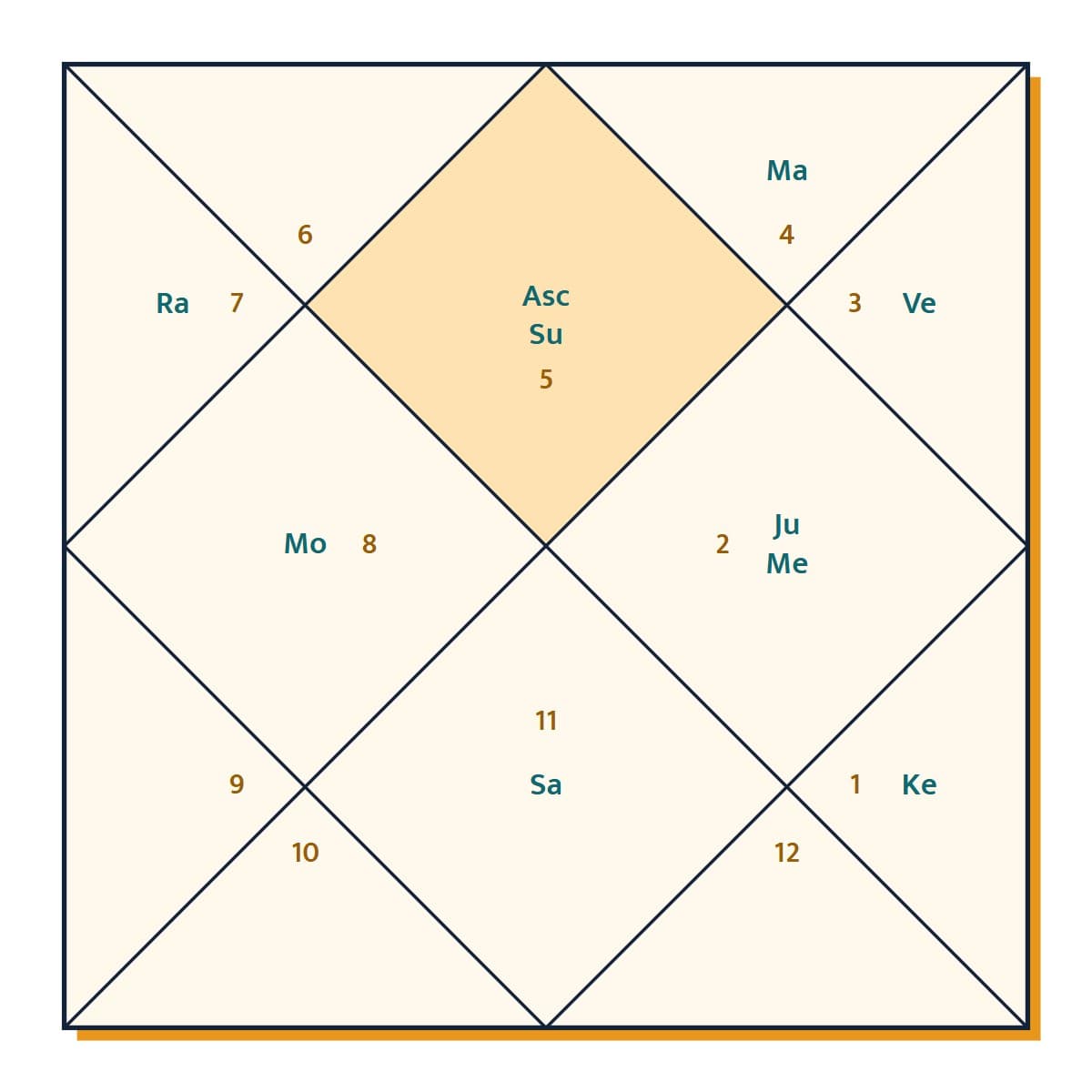
Most families in North India use the North Indian chart, a square divided into diamonds and triangles. The houses never move: the top-centre diamond is always the 1st house, and the houses run anticlockwise from there. The small numbers inside are not house numbers. They are sign numbers, 1 for Aries (मेष, Mesha) through 12 for Pisces (मीन, Meena). So if the top diamond shows 5, your lagna is Leo (सिंह, Simha).
The South Indian chart does the opposite: the signs stay fixed in a ring of 12 boxes, and the lagna is marked with a line or "Asc". The information is the same; only the drawing differs.
Step 1: Find your lagna (ascendant)
The लग्न (Lagna) is the sign rising on the eastern horizon at the moment you were born. It is the starting point of the whole chart. The lagna becomes your 1st house, the next sign your 2nd house, and so on round the zodiac. Jyotish treats it as the body and the self: how you meet the world.
Because the Earth turns, a new sign rises roughly every two hours, faster or slower depending on the sign and how far you were born from the equator. Two people born on the same day in the same city can have different lagnas. The planet that rules your lagna sign, the lagna lord, is the next thing a reader looks at. More in Lagna vs Rashi vs Nakshatra: your rising sign and Moon sign.
Step 2: How to read Kundli houses
Each house, or भाव (Bhava), is an area of life. This guide follows the Parashari whole-sign method, which VedaSpeak also uses: each sign is one full house. The methodology page lists the conventions.
| House | Classical name | Areas it describes |
|---|---|---|
| 1st | तनु (Tanu) | Self, body, temperament |
| 2nd | धन (Dhana) | Family, speech, savings |
| 3rd | सहज (Sahaja) | Siblings, courage, effort, short journeys |
| 4th | सुख (Sukha) | Mother, home, property, inner comfort |
| 5th | पुत्र (Putra) | Children, learning, creativity |
| 6th | अरि (Ari) | Obstacles, rivals, service, daily work |
| 7th | युवती (Yuvati) | Marriage, partnerships, the public |
| 8th | रन्ध्र (Randhra) | Change, the hidden, shared resources |
| 9th | धर्म (Dharma) | Father, teachers, faith, long journeys |
| 10th | कर्म (Karma) | Career, status, action in the world |
| 11th | लाभ (Labha) | Gains, friends, hopes |
| 12th | व्यय (Vyaya) | Expenses, letting go, foreign lands |
Readers group them. The kendras (1, 4, 7, 10) are the pillars of the chart. The trikonas (1, 5, 9) are the most auspicious. No single house is "bad": the 12th, for example, is also the house of life abroad, which matters to many Indian families living overseas.
Step 3: Meet the nine grahas
ग्रह (Graha) is usually translated as "planet", but it means "that which seizes": a force that takes hold. The नवग्रह (Navagraha), the nine grahas, are:
| Graha | English | Classical themes |
|---|---|---|
| सूर्य (Surya) | Sun | Soul, father, authority |
| चंद्र (Chandra) | Moon | Mind, mother, feelings |
| मंगल (Mangal) | Mars | Energy, courage, siblings |
| बुध (Budh) | Mercury | Intellect, speech, trade |
| गुरु (Guru) | Jupiter | Wisdom, teachers, growth |
| शुक्र (Shukra) | Venus | Love, beauty, comfort |
| शनि (Shani) | Saturn | Discipline, time, endurance |
| राहु (Rahu) | North lunar node | Desire, the unfamiliar |
| केतु (Ketu) | South lunar node | Detachment, the inner search |
Rahu and Ketu are not physical bodies. They are the two points where the Moon's path crosses the Sun's, which is why they are always exactly opposite each other. Uranus, Neptune and Pluto are not used.
To read a graha, ask three questions: which sign is it in, which house is it in, and which houses does it rule for your lagna? The same Shani (Saturn) means different things for a Leo lagna and a Libra lagna, because it rules different houses. That is why classical texts never call a planet simply good or bad.
Step 4: Your Moon sign, not your sun sign
If you have read Western horoscopes, you know your sun sign. Jyotish puts more weight on your चंद्र राशि (Chandra Rashi), the sign the Moon occupied at birth, because the Moon stands for the mind and moves fast enough to make each chart personal. In Indian practice, your राशि (Rashi) usually means your Moon sign.
There is a second difference. Western astrology uses the tropical zodiac, tied to the seasons. Jyotish uses the sidereal zodiac, tied to the fixed stars. The gap between the two, the अयनांश (ayanamsha), is now about 24 degrees. VedaSpeak uses the Lahiri ayanamsha, the one recommended by the Government of India's Calendar Reform Committee (1955) and the most widely used in India.
Example: someone born on 1 May is "Taurus" in a Western column, but their Sun is in sidereal Aries (Mesha). It is also why Mesha Sankranti, the Sun's entry into sidereal Aries, falls around 14 April, the date of Baisakhi, Vishu and Puthandu.
Step 5: Find your nakshatra
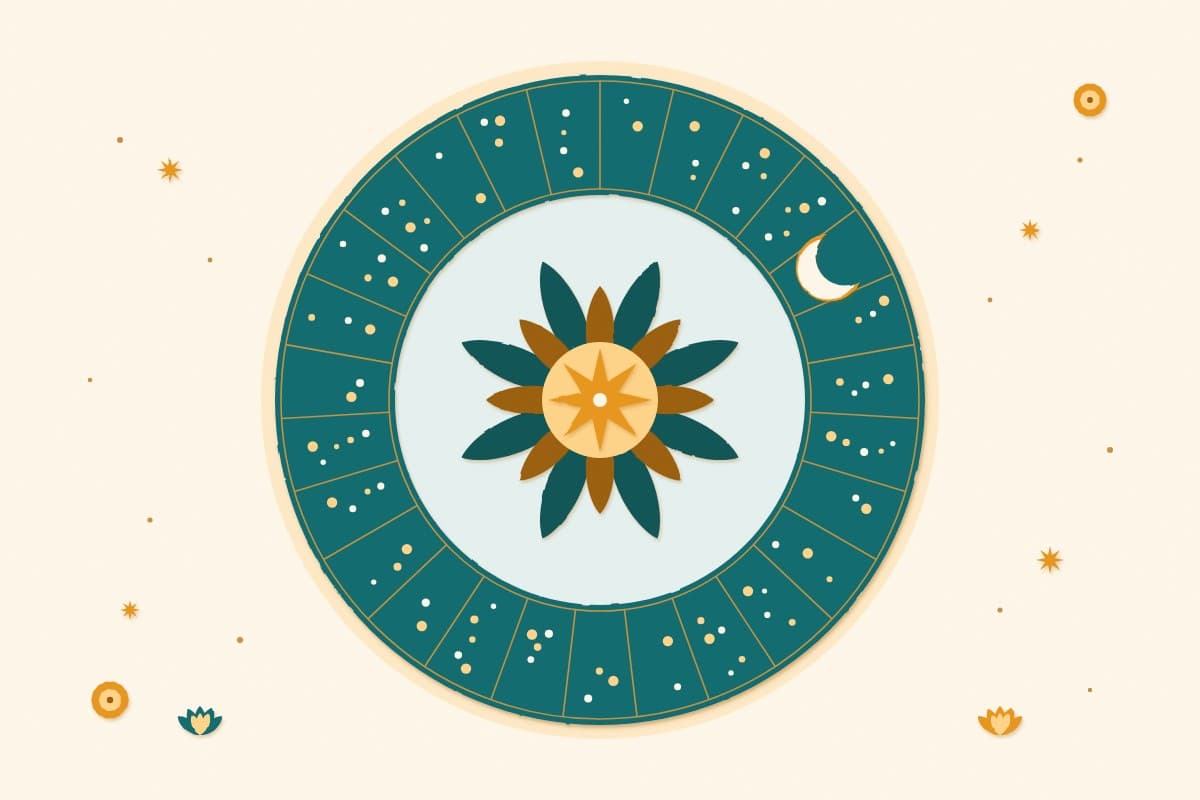
The zodiac is also divided into 27 नक्षत्र (Nakshatra), lunar mansions of 13°20' each, named after star groups such as Ashwini, Rohini and Magha. Each nakshatra has four पद (Pada), quarters of 3°20'.
Your birth nakshatra is the one the Moon was in when you were born. It colours temperament in a finer way than the sign, it traditionally guides the first syllable of a child's name, and it sets the start of your dashas.
Step 6: See where you are in your dashas
A Kundli also describes timing. The Parashari system most used for this is Vimshottari dasha, a 120-year cycle of planetary periods, and it is the system VedaSpeak uses. Each महादशा (Mahadasha), or major period, has a fixed length: Ketu 7 years, Venus 20, Sun 6, Moon 10, Mars 7, Rahu 18, Jupiter 16, Saturn 19 and Mercury 17. Each is split into अंतर्दशा (Antardasha), sub-periods.
Your first dasha belongs to the ruler of your birth nakshatra, and how much of it was left at birth depends on exactly how far the Moon had travelled through that nakshatra. A dasha does not decide events. It shows which grahas, and so which houses, are in focus for a stretch of years. A Saturn Mahadasha is often a chapter of patience and steady building; how it plays out depends on Saturn's place in your chart. To see how this reads in practice, look at the current-dasha sample (fictional profile). To find yours, see what is Mahadasha, and which one am I in?
What birth details you need, and why the time matters
A Kundli needs three things:
- Date of birth. Sets the positions of the slower grahas.
- Time of birth, as precisely as you have it. Sets the lagna, the houses and the Moon's exact degree.
- Place of birth. The town gives the latitude and longitude for the rising sign, and the time zone in force that day.
The time is the most sensitive part. The lagna can change sign within minutes if you were born near a boundary, and every house moves with it. The Moon travels about 13 degrees a day, so an hour's error can shift the starting point of your dashas by months, and occasionally your nakshatra. Divisional charts such as the नवांश (Navamsha, D9) are even more sensitive.
Old records add another trap. Clock rules have changed over the decades: India used "war time", an hour ahead of standard time, during the Second World War, and many countries move their clocks for daylight saving. VedaSpeak works out what the clock time on your birth record meant on that date, including time-zone and daylight-saving changes, and flags records that are ambiguous.
If you are not sure of your time, say so. VedaSpeak tells you when birth-time uncertainty could change the chart, so you know which parts of a reading to hold lightly.
What does Kundli mean? (Kundli kya hai, कुंडली क्या है)
A Kundli, or जन्म कुंडली (Janam Kundli), is a map of where the Sun, Moon and planets stood, against the stars, at the exact time and place you were born. The word comes from the Sanskrit कुण्डली (kundali), something circular or coiled, a fitting name for a chart of the sky that wraps around the Earth. You will also see it called janampatri, kundali or natal chart.
A Kundli is not a prediction. It is a record of a moment, calculated with astronomy. Interpretation comes afterwards, through the rules of a tradition. The most widely used rules are those of the Parashari school, named after the sage Parashara and set out in the बृहत् पराशर होरा शास्त्र (Brihat Parashara Hora Shastra). This guide follows those conventions.
Kundli questions, answered
How do I read my Kundli?
Start with the lagna and its lord, then the 12 houses, then where each of the nine grahas sits and which houses it rules, then your Moon sign and nakshatra, and finally your current Mahadasha and Antardasha. Read for patterns, not single placements.
Kundli kaise dekhe? (कुंडली कैसे देखें)
Pehle lagna dekhein, phir 12 bhav, phir har graha kis rashi aur bhav mein hai, phir chandra rashi aur nakshatra, aur aakhir mein chal rahi Mahadasha. North Indian chart mein upar beech ka diamond hamesha pehla bhav hota hai.
How do I read the houses in my Kundli?
Count from the lagna: the sign in the 1st house is your rising sign, and each next sign is the next house. Then read each house for its area of life and the grahas sitting in it. In the North Indian chart the houses stay fixed and the numbers show signs.
What is the difference between a Kundli and a horoscope?
In India the words are often used for the same thing: the birth chart. In English, "horoscope" also means a daily sun-sign column. A Kundli is calculated for one person, from their own date, time and place of birth.
Can I make a Kundli without my birth time?
You can place the planets in signs and approximate the Moon, but not a reliable lagna or houses. A reading should say plainly what it cannot see. Even an approximate window helps.
Does AI calculate a Kundli?
At VedaSpeak, no. Chart placements are calculated by a deterministic engine; AI explains the chart in plain language and does not invent the Kundli. The FAQ covers how your data is handled.
Can a Kundli tell me exactly what will happen?
No. Jyotish describes tendencies and timing to reflect on, not certainties. It is no substitute for professional advice.
Astrology is an interpretive tradition, not a science. For reflection only; not medical, legal or financial advice. Answers are generated by AI from your calculated chart.
Sources
- Parashara, Brihat Parashara Hora Shastra, trans. R. Santhanam (Ranjan Publications, 1984), chapters on signs, houses (bhavas), grahas and Vimshottari dasha.
- Varahamihira, Brihat Jataka, trans. V. Subrahmanya Sastri; on rising signs and the houses.
- Mantreswara, Phaladeepika, trans. V. Subrahmanya Sastri; house significations.
- B. V. Raman, How to Judge a Horoscope, Vols. 1–2 (Motilal Banarsidass); house-by-house reading.
- B. V. Raman, Hindu Predictive Astrology (UBS Publishers); nakshatras and dashas.
- Government of India, Report of the Calendar Reform Committee (CSIR, 1955), chaired by M. N. Saha; recommendation of the Lahiri (Chitrapaksha) ayanamsha.
- "Nakshatra", Wikipedia (accessed 31 Oct 2026): 27 nakshatras of 13°20′, four padas each.
- "Ayanamsa", Wikipedia (accessed 31 Oct 2026): sidereal vs tropical offset, Lahiri about 24° in 2026.
- NASA, StarChild: What is the orbital period of the Moon?: sidereal month of about 27.3 days (the Moon's ~13° a day).
- VedaSpeak, Methodology, Pricing and FAQ (checked 29 Oct 2026).